An error has occurred. Please try again.

Loading...
Memorial Window from Church of the Lord’s Prayer, Baird
Diocesan News
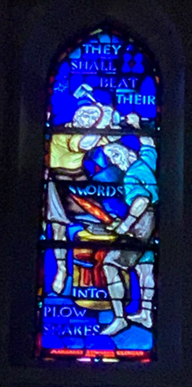 One of my favorite stained-glass windows in the clerestory of the Church of the
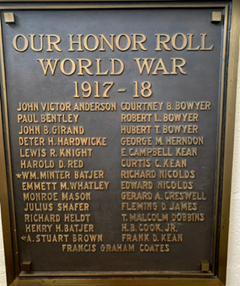 Heavenly Rest shows a pair of bladesmiths hammering a glowing sword. Like all our clerestory windows, this one depicts a passage from the Old Testament: “They shall beat their swords into plowshares” (Isaiah 2:4, Micah 4:3). Less unambiguously hopeful, but no less vivid, are the tokens of our parishioners’ involvement in the wars of the twentieth century: a World War I memorial window in our All Saints Chapel, and "Honor Rolls” of our veterans from World War I and II. Gold Stars denote those killed in action. My wife and I live in a home previously owned by the younger brother of one of those Gold Star soldiers—Corporal William Minter Batjer, killed June 17, 1918 in Cantigny, France.
Do these war memorials record acts of selfless service? Or is it the long reach of the great tragedies of the previous century? I think the answer must be both.
 We live that cognitive dissonance in our Prayer Book liturgies, which include thanksgivings “For Heroic Service” alongside prayers “For Peace Among the Nations,” and “For our Enemies.” We live it in the Calendar of the Church Year, which has preserved the ancient Feast of St. Martin of Tours on November 11, alongside Veterans Day and Armistice Day. And I’ve lived that contradiction in my own life: as a veteran of the war against ISIS, and now a deacon who is also a “bivocational Airman” still serving in the Air Force Reserve.
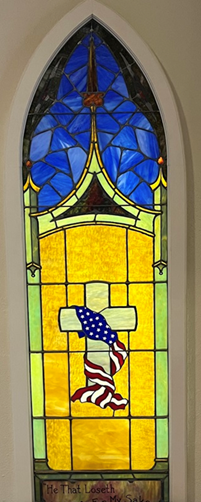
The first time I visited the Hulsey Episcopal Center in Lubbock I found my eyes drawn to the stained-glass window built into the wall between the stairwell and the conference room. It depicts an American flag wrapped around a small cross. Beneath the cross is written “He That Loseth His Life For My Sake Shall Find It” (Matthew 10:39, in King James English). The Hulsey Center had previously been a home belonging to Mr. Warren Bacon, so I assumed the window must have been a relic from a church somewhere—but I never learned its story until a few months ago.
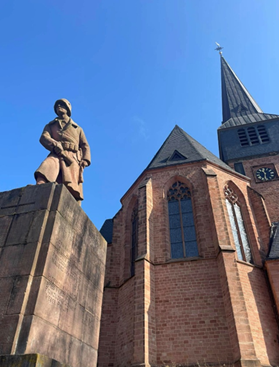 In December 2024, my wife Amanda and I both moved to Germany temporarily for work: her as Faculty in Residence at Abilene Christian University’s campus in Leipzig; me for a six-month deployment on the staff of U.S. Air Forces in Europe. One of our favorite places near my workplace at Ramstein Air Base was Hohenecken, a charming little village that has become a neighborhood within the larger city of Kaiserslautern (population: 101,486).
Whenever we would hike up to the Burg Hohenecken—a 13th century castle atop Schlossberg hill—we would pass by the World War I memorial in front of the St. Rochus Catholic Church. The column beneath its statue of a German soldier records the names of the village’s war dead. Beneath those, it reads “Den guten kampf habe ich gekämpft” (“I have fought the good fight,” 2 Timothy 4:7) and “Selig sind die Toten, die in dem Herrn sterben” (“Blessed are the dead who die in the Lord from now on,” Revelation 14:13).
We often took visitors from the United States, and they were invariably moved as we had been by the common humanity and common hope the monument expressed.
 Closer to my wife’s Leipzig apartment, the price Germany paid for the World Wars is starkly visible in Berlin. The reconstructed Reichstag still bears bullet holes and Soviet graffiti. The façade of the old Anhalter Bahnhof suggests the scale of the grand train station destroyed in the war and never rebuilt.
Signs of hope are visible as well. During our January visit, our hotel faced the 18th century Französischer Dom (“French Cathedral”). Originally built for Huguenot (Calvinist) French refugees, a small French Reformed congregation still held services there even during World War II, until the destruction of the nave by aerial bombardment on May 7, 1944. In the 1970s, the church was saved by Détente, financial support from West German churches, and the special solicitude of an East German government desperate for western cash. A “special construction program” enabled the restoration of up to 45 churches deemed worthy of monument status. The Französischer Dom reopened on Easter 1983. We attended a beautiful bilingual French and German service there on January 26.
A few months later, my wife and I planned a brief trip to France’s Champagne region. We’d previously passed it on a weekend road trip to Paris. (What a blessing to be able to drive to Paris as easily as Amarillo!) We had also passed the distinctive brown road signs (panneaux marron) marking the exits for the World War I cemeteries managed by the American Battle Monuments Commission (ABMC). There was something uncanny about the way it felt as normal as driving past a National Park Service sign for a Civil War battlefield. I resolved that on the way back from Champagne, we would stop off at the largest of those ABMC cemeteries—the Meuse-Argonne American Cemetery—to visit the memorial marker for Lieutenant Frank Luke, the future Air Force’s first Medal of Honor recipient.
First though, I had to get through my SOM weekend! During my time abroad, I spent one Saturday each month on Zoom from 4pm to midnight with my classmates and priest mentors at our diocesan School of Ordained Ministry. This particular day, Fr. Jim Haney and Fr. Jared Houze put on the agenda a tour of significant objects in the Hulsey Center. As Fr. Jared carried “virtual me” around on a laptop, Fr. Jim narrated the history of various relics from parishes around the Diocese. One of those happened to be a small plaque I had somehow never noticed before, below the mysterious stained-glass window. It read:
Memorial Window from Church of the Lord’s Prayer Baird, closed 1964
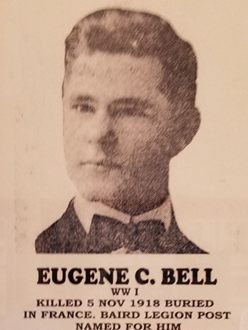 In memory of
Pvt Hubbard MacDonald Bell
Company F, 3rd Infantry
Born October 1, 1897
Died November 7, 1918
and
1st Lt Eugene Carter Bell
Company B, 359th Infantry A&F
Born October 21, 1894
Died November 1, 1918
I had never known we’d had a congregation in Baird, let alone that this window was associated with it. I asked Fr. Jim to re-read the names and quickly jotted them down. After class wrapped up, I searched the Internet for information about these two young men. As I suspected, they were brothers. They were also sons of a prominent Callahan County lawyer and grandsons of a Civil War veteran from Virginia. And while Hubbard M. Bell was buried in Texas, Eugene Carter Bell was interred at the Meuse-Argonne American Cemetery.
Two days later, we drove through intermittent spring rains on winding roads through the stunning French countryside. Off the A4—the French version of the Interstate—for the first time on our trip, the experience felt strangely Texan. It reminded me of a greener version of the region known as “the Big Empty,” east of Lubbock and north of Abilene. We passed through tiny villages with names like Neuvilly-en-Argonne, Boureuilles, and Charpentry. Old churches dotted the townscapes, just as they do in Seymour, Haskell, and Baird.
We also passed the Cimetière Allemand de Épinonville, one of many German cemeteries maintained with French assistance even during the fraught interwar years between 1918 and 1939.
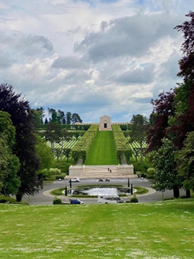 Approaching the Meuse-Argonne American Cemetery from the west, we drove through increasingly thick woodlands before entering the village of Mairie de Romagne-Sous-Montfaucon. On the east end of town, we found the cemetery enclosed by a stone wall lined with shade trees. From the road, the entrance is marked by a broad iron gate and stone pylons; immediately behind, a long central avenue beckons you toward the reflecting pool at the center.
The cemetery is designed along an east–west axis. From the west entrance on the D123, we could see all the way across the central mall to the east entrance. The central mall falls within a natural valley, with rising terrain on both sides. After reaching the east end, we circled back north and west to the visitor center. From there, we looked down to the central reflecting pool and across to the Memorial Chapel on the south end. On the slope between the Memorial Chapel and the central mall, we saw 14,256 graves—mostly Latin crosses, with 268 Stars of David. 22 of the graves represent sets of brothers, like the Bells. Inside the visitor center, we looked at a small exhibit about the 1918 Meuse-Argonne campaign and looked up where to find the graves of Frank Luke and Eugene C. Bell.
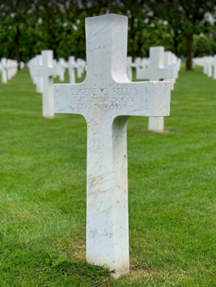 Like the other eight Medal of Honor recipients buried there, Luke’s name was spelled in gold letters on his white marble cross—above it, a gold star. Eugene Bell’s memorial was plain, like most of the rest. It evoked the aspirational equality of Pershing’s citizen army, and the spiritual equality in death that we recognize by placing all caskets and urns beneath identical, simple white palls at funerals. I wondered when someone from West Texas had last come to visit.
The Memorial Window had originally been placed at Baird’s Episcopal Chapel of the Lord’s Prayer by the brothers’ older sister, Nan St. Clair Bell Philips. She lived most of her life in Big Spring, and died in 1972. The church building was sold in 1961 to a group, no longer extant, called “God’s House of Prayer.” At the time of the sale, its lectern went to St. Mark’s (Coleman), the baptismal font to St. Peter’s (Borger), and the prayer desk to Good Shepherd (Brownfield)—located today at Texas Tech’s National Ranching Heritage Center under its original name, Trinity Mission. Baird’s Memorial 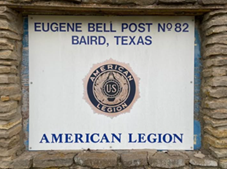 Window was installed in the Hulsey Episcopal Center during the 1982-83 conversion from home to office building under Bishop Sam Hulsey. When the church closed, its remaining families began attending Trinity Episcopal Church (Albany). Baird’s American Legion Post, named for Eugene Bell, remains active to this day. His brother Hubbard is interred in Baird’s Ross Cemetery. Beneath Hubbard M. Bell’s own cross-shaped marker are the words of John 15:13, “Greater love hath no man than this, who lay down his life for his friends.”
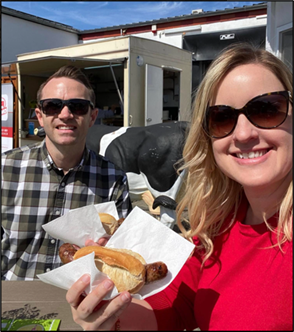 As we neared our own temporary village of Mackenbach, Germany, we stopped in the neighboring town of Weilerbach—home of the nearest grocery store—to pick up provisions for the coming week. We were tired and getting more than a little hungry. Noticing a crowd gathered in the parking lot of a locally famous butcher shop (ZEMO, known for its after-hours meat vending machines), we stopped to take a look. People were clustered around a tent, tables, and a grill. An orderly line weaved around the tent, where people were paying cash, to the grilling station. Might as well eat here, we quickly decided.
When we got to the front of the line, we discovered this was a charitable initiative of the local Freiwillige Feuerwehr, or as we call it in West Texas, “Volunteer Fire Department.” Weilerbach’s firefighters were raising money to support the Landstuhl Regional Medical Center’s Fisher Houses—homes away from home for the families of wounded soldiers, sailors, airmen, and Marines. Founded in 1990 by construction magnate Zachary Fisher, the Fisher House Foundation has helped build over ninety such homes in the U.S., UK, and Germany.
I’d known about Fisher Houses since the 2000s, but it had never occurred to me that the people of another land—let alone citizens of a country we defeated in two wars—would feel moved to support wounded American servicemembers and their families. And being there felt so normal, as if I was at a Rotary or Lions Club event in my hometown, only with a mixed crowd of Rhineland-Pfalz Germans and American airmen. The meal was what St. Paul called an agape feast, with bratwurst and beer in place of bread and wine.
Eugene Carter Bell and Hubbard MacDonald Bell died only days before the fighting stopped with the Armistice on the Feast of St. Martin.
In the fourth century, Martin had become the bishop of Tours in western France, but he grew up in modern Hungary. Tradition holds that one frigid day, this Roman soldier cut his cloak in two to share with a beggar near Amiens. That night, Martin saw a vision of the risen Jesus wearing the half he’d given away. “Martin, who is still but a catechumen, clothed me with this robe,” Jesus said. A Roman legionnaire became a soldier for Christ and served the people of France for the rest of his life.
The same love that once tore a military cloak in two, still tears down walls, unites strangers across oceans, and makes enemies into friends.
The Rev. Joe Biles is Curate and Pastoral Assistant at the Episcopal Church of the Heavenly Rest (Abilene) and Trinity Episcopal Church (Albany).