My name is Andrew Wright, by God’s grace a beloved child of God, called as a priest and currently serving as the Canon to the Ordinary in the Diocese of Newark, in northern New Jersey. My focus in ministry is to seek Christ in the midst of community and relationship and to help form followers of Jesus to carry out God’s mission of love, mercy, and justice. In short, to change the world. Here is a little of my background, to provide some personal context.
In terms of family, I was married for 23 years and have been divorced for 12 years; we have three adult children, Aidan, Naomi, and Macrina. They are in their 20s and 30s and we’re now a “tri-coastal” family, of sorts, with my son in Portland, Oregon, one daughter in Queens in NYC, and one daughter still in Texas, in DFW. I enjoy seeing them as often as I can. Happily, I have been in a long-term relationship since 2020, here in New Jersey. I also have a cat, Mjölnir.
In my downtime, I enjoy all kinds of storytelling, especially books, comics, movies, and theatre. I enjoy the rare opportunities I’ve had to perform in community theatre and produce and direct youth theatre, but mostly I’m happy to be in the audience. I am always up for a trip to an art museum or spending time stargazing.
I’m originally from the Diocese of Northwest Texas, was born, baptized, and grew up in Borger, at St. Peter’s Episcopal Church, but all of my time in ministry as a priest has been away from home. My family was very involved in our parish. I participated as an acolyte, in Sunday School, and in youth group. My parents were also active in the diocese; we attended Diocesan Convention most years as a family trip. Diocesan youth ministry was a significant part of my faith development, first through summer camp in Amarillo, and later through youth programs and events during the school year, especially Happening. My home parish was the starting point for my faith, but it developed and flourished with my peers in these diocesan programs.
My time during college at Texas Christian University in Fort Worth was one of discernment and discovery. I began college headed in one direction, physics, math, and Air Force ROTC, but soon realized that I might be called to something different. The local Episcopal church across the street had a small chapel open 24 hours and I spent many evenings and late nights there praying and thinking through what to do with my life. During college, I served as a youth minister at another local parish during the year and worked at Quarterman Conference Center in Amarillo as a camp counselor each summer. Those summers were intensive times of discernment. By my Junior year, I had begun the ordination process with my home parish (leaving ROTC) and changed my major to Philosophy. After graduation and getting married, I spent a year in Abilene, finishing out the process for postulancy and assisting with the youth group at Church of the Heavenly Rest.
We moved to Sewanee, Tennessee, for seminary, where our first child was born. It was a rich time of formation and making lasting friendships with classmates. In addition to my classes, I learned a lot about being newly married and being a new parent. I also learned about conflict, observing a divided faculty and dean, an unexpected but valuable learning experience.
I was ordained to the diaconate by Bishop Sam Hulsey in 1995 in Borger and began serving the following Sunday at my first call, as Assistant Rector at St. Paul’s, Murfreesboro, Tennessee. My work focused on youth ministry, Christian education, and campus ministry. Our second child was born while we were in Murfreesboro and I was ordained to the priesthood there in 1996. I was called to St. James’, Fremont, Nebraska, as Rector in 1999, where we had our third child.
In both of these parishes, I discovered more about myself and those I was serving. I learned better how to exercise leadership as a priest, how to understand and develop congregational systems, and, more importantly, how to develop leaders and help form others in their own faith. Those first parishes taught me a great deal about being a priest and I am forever grateful to them. During this time, I also began to discern a calling within my priestly vocation, focused on formation, study, and teaching. When my spouse took us to New York City for her seminary coursework, I started working on advanced degrees in Liturgical Theology and Systematic Theology. Given that we were both in graduate school in NYC, with 3 young children, I also worked multiple part-time jobs to keep our household afloat. After her graduation, I served in parishes part-time in Maryland while continuing work on my dissertation and raising our kids.
From Maryland, we made our way back to Texas in 2009, to be closer to my mother after my father’s death. They had settled in Waxahachie, south of Dallas, and I was called to a nearby parish in DeSoto as Rector. While there, I completed my work on my Doctor of Theology degree from the General Theological Seminary and graduated in 2012.
In 2013, I saw a notice for an assisting position in the nearby Diocese of Fort Worth, where my spouse was serving at the time. While I loved my parish and my work as Rector, this position’s focus on children, youth, and young adults was very interesting. This was the same church across from TCU that I had attended and visited so often when I was wrestling with discernment in college. It was a full circle moment. I met the Rector, the Rev. Carlye Hughes, and we found that we had a similar approach to ministry and compatible working styles. I accepted the call as Associate Rector at Trinity Church in Fort Worth, serving 5 years in that role and then 1 year as Interim Rector, after she was elected Bishop of Newark. Fort Worth provided many opportunities to be involved at the diocesan level and I particularly appreciated my time as Secretary of the Diocese. The significant life event during this tenure in Fort Worth was, sadly, the dissolution of my marriage. We worked very hard to ensure that our kids, all teenagers at that point, had as much stability as possible during this time.
While in Dallas and Fort Worth and afterwards, I began teaching part-time occasionally: as a Chaplain and Theology teacher at an Episcopal High School, in the diocesan school for Dallas, at Brite Divinity School at TCU, at Sewanee in their non-degree program, and at Drew University in New Jersey. I continued as an adjunct for several years, even after moving to New Jersey. My work as a scholar has also led to membership in various organizations, including the North American Academy of Liturgy and Societas Liturgica, helping me to remain connected to my field of Liturgical Theology. I have had the opportunity to write as well, serving as general editor and contributing to the 3-volume Planning for Rites and Rituals and co-authoring an essay in The Oxford Handbook of the Book of Common Prayer. I also serve on the General Board of Examining Chaplains for the Episcopal Church, which oversees the General Ordination Exams.
In 2019, Bishop Hughes asked me to serve as Canon to the Ordinary in the Diocese of Newark. For the last 7 years, I have worked to support parish and diocesan ministries, provided pastoral support to the clergy and to lay leaders, and assisted Bishop Hughes in carrying the mission of the diocese forward. Areas of focused work have included responding to urgent concerns (such as our diocesan COVID-19 response), developing a School for Ministry to train lay leaders, revamping the Commission on Ministry, and restructuring diocesan staff. It has been both challenging and fulfilling to work at the diocesan level and I am thankful for the opportunity to serve in this capacity.
Across my life, I am aware that I have been formed by many communities and people along the way, and I hope that I have contributed to the growth of those I have met as well. Building and developing community is so incredibly important; it’s how we grow and learn. That’s true generally, but especially in life in Christ. Jesus gathers us in communities to form us into his people, a people of God’s love, mercy, and justice. He forms us as community into the Body of Christ to transform and change the world here and now, to turn it upside down. We don’t do that alone, but together, through our churches, through our various ministries and communities, and through our families, whether by birth or by choice. I am so thankful for all those who have shaped me, from Borger to Newark, and I carry them with me every day in the ministries in which I serve.
Why I Feel Called to Discern with the Diocese of Northwest Texas
I feel called to discern with the Diocese of Northwest Texas because of a persistent sense of connection and rootedness and because we share much in common, in terms of how we approach ministry, community, and leadership. Though my ministry as a priest has been exercised almost entirely outside of the boundaries of Northwest Texas, I have always felt deeply connected to the diocese, growing up there, discerning my call there, and being sent off to seminary from there.
When a colleague read through your profile, they were surprised at how closely the values expressed in the profile matched my own ministry style – elements such as shared ministry, collaboration, accessibility, and a practical and humor-infused approach. It didn’t surprise me. I responded, “Well, those are the people that shaped me, in my hometown, at camp, and diocesan events.” How I understand the Church, ministry, and my own vocation was deeply formed in Northwest Texas. This discernment, however, is not simply about returning to a once-familiar place, but about attending to a community that helped form me and asking whether I am now being called to serve this diocese in a new way.
That familiarity gives me some sense of the region’s culture, climate, geography, and patterns of life, but familiarity alone is not a calling. The question for me is whether I am being called to learn Northwest Texas again in a new way, this time as a servant and leader alongside you.
In discernment, it is often the differences, not just the familiarities, that open space for learning, growth, and new faithfulness. The diocese I know is from a different time. I shouldn’t have been surprised to see on the map in the profile that my home parish, St. Peter’s, Borger, is now the northernmost outpost of the diocese, but of course it did surprise me. I know a particular chapter of the history of the diocese, and know it well, but there is much about who you are now and what your mission and ministry is now that I will be learning in this process. And that's exciting for me—the possibility of mystery and new discovery, of learning where the energy is in a community for ministry. I am excited to learn Northwest Texas in a new way.
And that mystery and discovery works the other way around too. You all (or your predecessors, perhaps) knew me and my family. My parents, Ken and Marcia, were very active lay ministers in the diocese. You did discernment with me as a college student and sent me off to seminary in 1992 at the age of 23 and then to minister in the wider Church. Naturally, I am also different than I was when you all sent me off. I have spent the last 30+ years serving in a wide variety of ministry settings: small and large congregations, campus ministry, youth ministry, school chaplaincy, interim ministry, and diocesan leadership. I even went back to school, (apparently three years of seminary wasn’t enough for me), and earned additional degrees in liturgy and theology – and also have had the opportunity to teach as an adjunct in local diocesan schools, in ecumenical divinity schools, and in some of our Episcopal seminaries. I have wandered through other regions and dioceses, some far off and quite different from Northwest Texas, and some much closer to home. I have gained experience, perspective, and various skills and approaches to ministry.
For the last 7 years, of course, I have been serving in a diocesan role, in the Diocese of Newark, in New Jersey. At first glance, this seems to be about as different a ministry setting from Northwest Texas as one can imagine. New Jersey is one of the most densely populated states in the US and a significant portion of this diocese is focused on one of the largest urban centers in the world, New York City. Don’t even get me started on driving in New Jersey. While all of that is true – it is a radically different setting – it is also a diocese that is trying to learn new models and forms for ministry that are more grounded in our common baptismal ministry, with a renewed emphasis on lay ministry. Of our 90 or so congregations, about 35 have no regular clergy and are unlikely to be able to call someone. Some of these churches rely on a very limited list of supply priests and, increasingly, lay ministers to lead Morning Prayer or Ante-Communion and to preach. We are training increasing numbers of Worship Leaders, Preachers, as well as Pastoral Leaders – all licensed lay ministries – to assist our churches in finding new ways to do ministry with or without regular clergy. More and more churches are experimenting with how to share clergy, parish staff, and ministry resources, even across some distance (NJ distances, granted, not NWT distances, but still significant). However, this opportunity to form and lift up lay ministry isn’t just about filling the gaps created by a clergy shortage or the increasing costs to maintain a full-time priest. This is an opportunity to provide the teaching, training, and support to enable the baptized people of God to live more fully into their ministry – which they are. It’s tremendously exciting to see the impact of these lay leaders on their parishes and communities. I suspect this description has some resonance with Northwest Texas, even with very different contexts and scales.
Sometimes, of course, small and struggling churches are no longer able to continue in their ministry and end up closing. Most often, the remaining members are just no longer able to carry on. Part of my current role is to support and walk alongside congregations when they decide that it’s time to close, a kind of hospice ministry, supporting parishioners as they grieve, helping them to find new church homes, and attending to the practical matters of property and records that remain. The COVID pandemic accelerated church closings here, as it did across the Church.
The background circumstances and causes of these changes in parish ministry may differ somewhat between Newark and Northwest Texas, but the underlying questions in both places are not so different: how to sustain congregations (often with limited clergy), how to form lay leaders for ministry, and how to respond faithfully to a world in a period of rapid change. My time in this role as Canon to the Ordinary has also been a time for me to sharpen and develop my skills in administering and organizing a diocese and to learn up close what the role and challenges are for a bishop in the church today.
Sewanee, where I attended seminary, has always sought to form priests that are “devout, learned, and useful.” I often return to this framework in my ministry. To be devout includes taking our baptismal promises seriously and seeking God’s presence in the midst of a challenging and chaotic world. To be learned is to bring careful judgement and the gifts of reason to the work of the Church. And to be useful is to attend to the practical work of ministry, to roll up our sleeves and serve in ways that make a real difference in people’s lives. This framework continues to shape how I approach ministry, and it also shapes how I would approach discernment with you: seeking to be faithful, thoughtful, and genuinely useful in the work God may be calling us to do together.
Part of my discernment with you is to see whether my experience, formation, and gifts might serve the Diocese of Northwest Texas in this moment, and whether together we might build one another up, equip each other, for the work that God has set before us – centered in our devotion to the Lord Jesus, using all of our acumen and insight and education, and, finally, making a real difference in this world, that the reign of God may be more and more visible among us. I’m intrigued that this discernment may not be accidental, but part of a longer arc of formation and ministry across my life that may now be turning back toward Northwest Texas.
For me, this is not simply a return to a familiar place, but a genuine question of call: whether the place that helped form me is now a place I am called to serve. I am actively discerning the possibility that I may be called to be your next bishop. I bring experience and expertise and knowledge, but that’s not the heart of the matter, really. The heart of the question that we both are asking is how we may relate to each other, how we would minister together, and whether God is calling us into this new direction together. Are we called to serve together in this way to share the love of Christ in a conflicted and desperate world? I would be honored to be considered and would see this as the call of a lifetime of ministry.

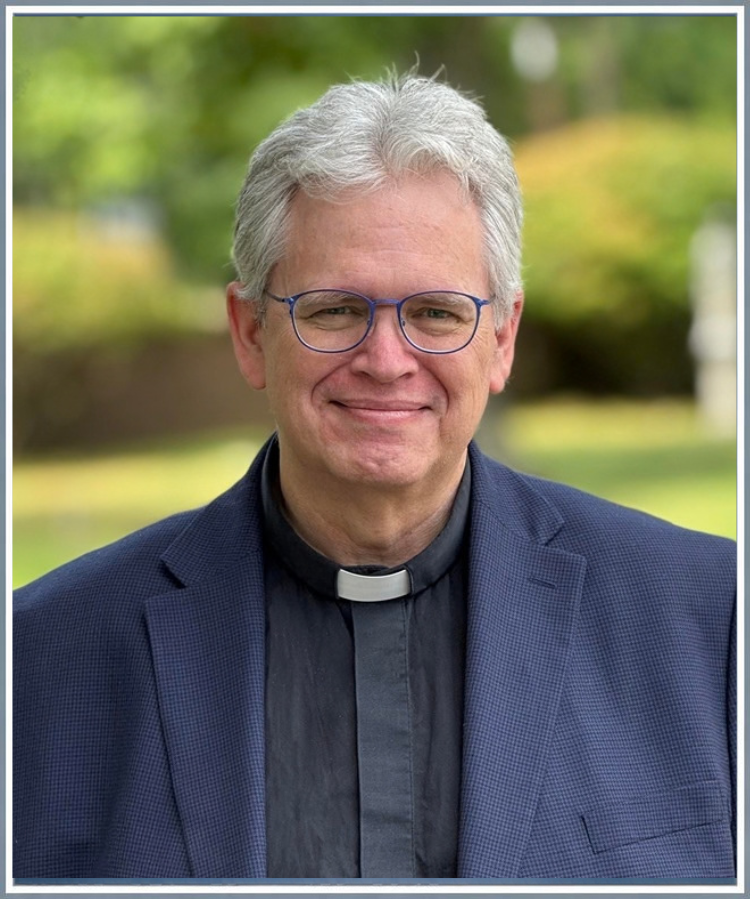 The Rev. Canon Andrew R. Wright, Th.D.